Plenty of work, fewer ways in: the job market to 2035
Official projections have paid work growing in the US and the EU to 2035. AI does its damage first through who gets hired: in the US, employment of workers aged 22 to 25 in highly AI-exposed jobs is about 19% below trend, while experienced workers in the same jobs show no comparable gap. In this report I follow ten people from 2026 to 2030, and into three possible futures for 2035, to show what that means in a working life: who loses a job, how long the search takes, what the next job pays, and which retraining has measured results.
The ten people are invented. Each one stands for a large group of workers, and their stories follow the published figures for that group. Where a story goes further than the figures, the report marks the step S and lists it as speculation.
Seven numbers from the report.
below trend: employment of US workers aged 22 to 25 in highly AI-exposed jobs in June 2026, against similarly aged workers in less-exposed jobs. Experienced workers show no comparable gap.
jobs projected for the US economy from 2025 to 2035, growth of 3.5%. For the EU-27, Cedefop projects employment to grow by over 4% between 2023 and 2035.
projected change in US office and administrative support jobs from 2025 to 2035, the fastest decline of any major occupational group: 752,100 fewer jobs.
how long the median unemployed American had been looking for work in August 2026. The average was about 6.1 months, because a minority stays out far longer.
of US workers laid off after three or more years who found full-time work again earned as much as before, or more (January 2026). Two years earlier the share was 62%.
earnings gains after training ended, in randomised trials of several US sector-focused training programmes. Not all training works: a US trial of federally funded (WIOA) training found inconclusive evidence that it raised employment or earnings.
of Romanians aged 15 to 29 were neither in work nor in education or training in 2025, the highest share in the EU. The EU average was 11.0%.
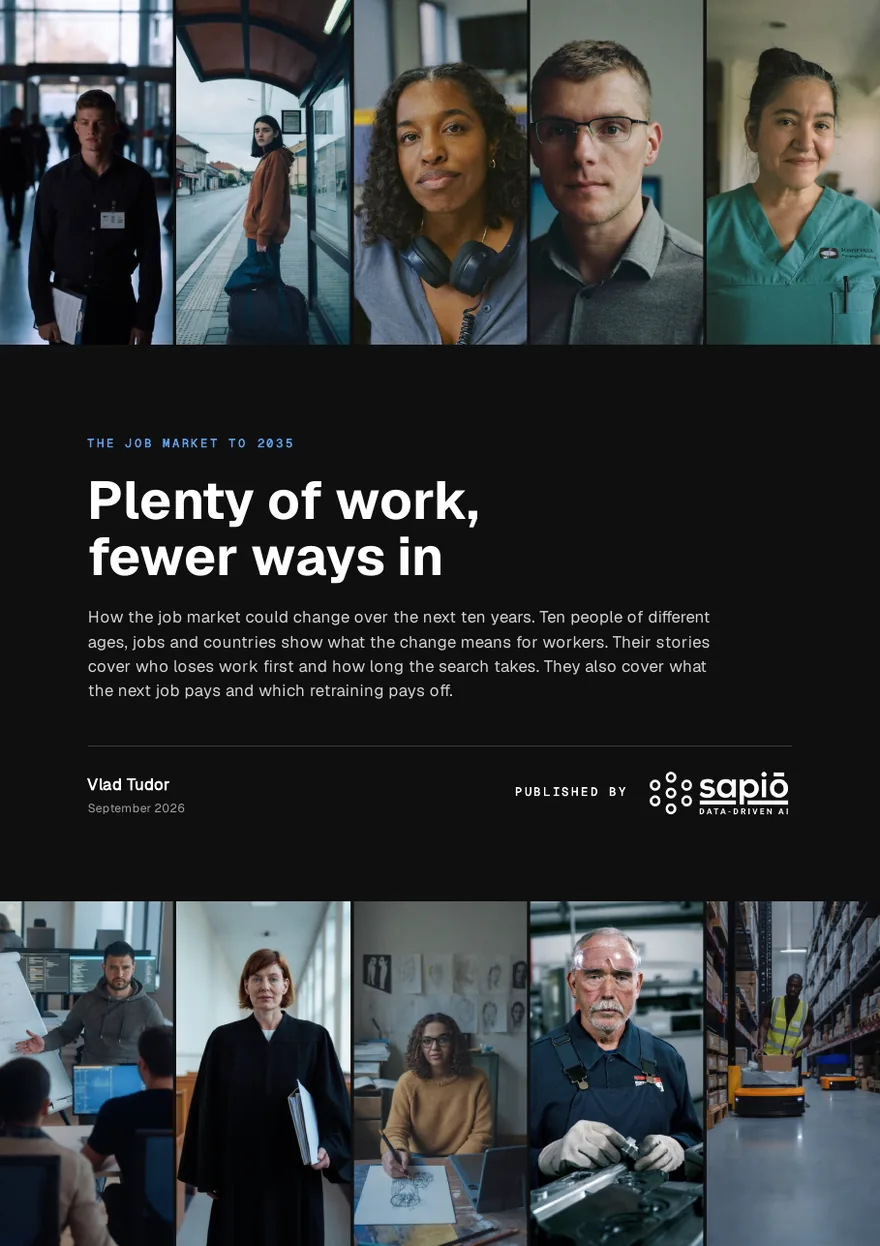
Eight chapters, ten people.
Each chapter follows one or two of the ten people through the figures for their group. The last one puts all ten in three futures for 2035. None of the futures is a forecast.
Young people find it harder to get a first job in work exposed to AI
Jake, 23, graduate, Ohio · Andreea, 21, near Mediaș
Office jobs are shrinking, and many laid-off workers earn less in their next job
Denise, 44, customer service, Kentucky · Thomas, 41, accounts clerk, Leipzig
US home care jobs are projected to grow, but the typical aide earns about $2,980 a month
Rosa, 52, home health aide, Arizona
Companies hire fewer junior software developers, while experienced staff hold steady
Radu, 34, software developer, Bucharest
Freelance illustrators and writers are losing income to AI
Léa, 31, freelance illustrator, Berlin
In-house lawyers are the fastest-growing part of Germany's legal profession
Katrin, 47, lawyer, Kassel
Robots take over warehouse work, and German car plants cut jobs for reasons not traced to AI
Marcus, 36, warehouse worker, Indiana · Jürgen, 57, auto-parts worker, near Stuttgart
Official forecasts show more jobs in 2035, but a first job may get harder to find
All ten, in three futures for 2035
How the figures were checked.
The report draws on over 100 sources: official statistics from the US Bureau of Labor Statistics, Eurostat, Cedefop, Germany's Federal Employment Agency and Romania's ANOFM, research papers, and a few industry and vendor surveys, labelled as such.
Every figure has an entry in a fact ledger. Each source page was fetched, and a figure stayed in only if the page contained the sentence it rests on; that sentence is stored with the entry. Computed figures, such as months worked out from weeks, show their arithmetic. Figures behind a paywall, or with no sentence to match, were left out.
Projections are labelled as projections and scenarios as scenarios. Where the report draws a straight line through two readings, it says so, and says that a straight line forecasts nothing.
The research was AI-driven, which is why I made the checking mechanical: a number goes in only once it matches its source. Figures are as published by 23 September 2026 and cover the US and the EU, with Germany and Romania in detail.
Who is behind it.
Vlad Tudor
I am a Romanian AI engineer and the founder of Sapio AI. I build AI systems for companies, and I speak and write about what AI changes at work.
Sapio AI
The Bucharest AI studio I founded in 2021. It builds custom AI systems for companies.
Want to discuss the findings at your event or in your story?
I talk about this research at conferences and events, on podcasts, and with journalists working on a story. Tell me what you have in mind.
Reply within 24 hours on working days