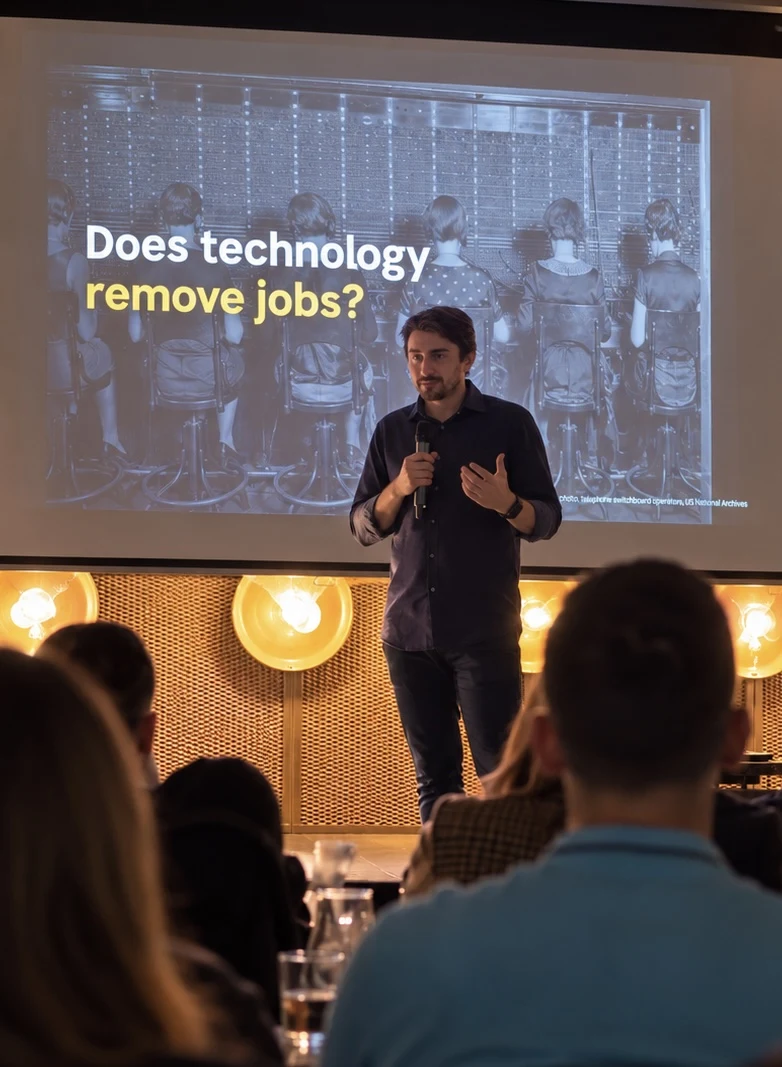
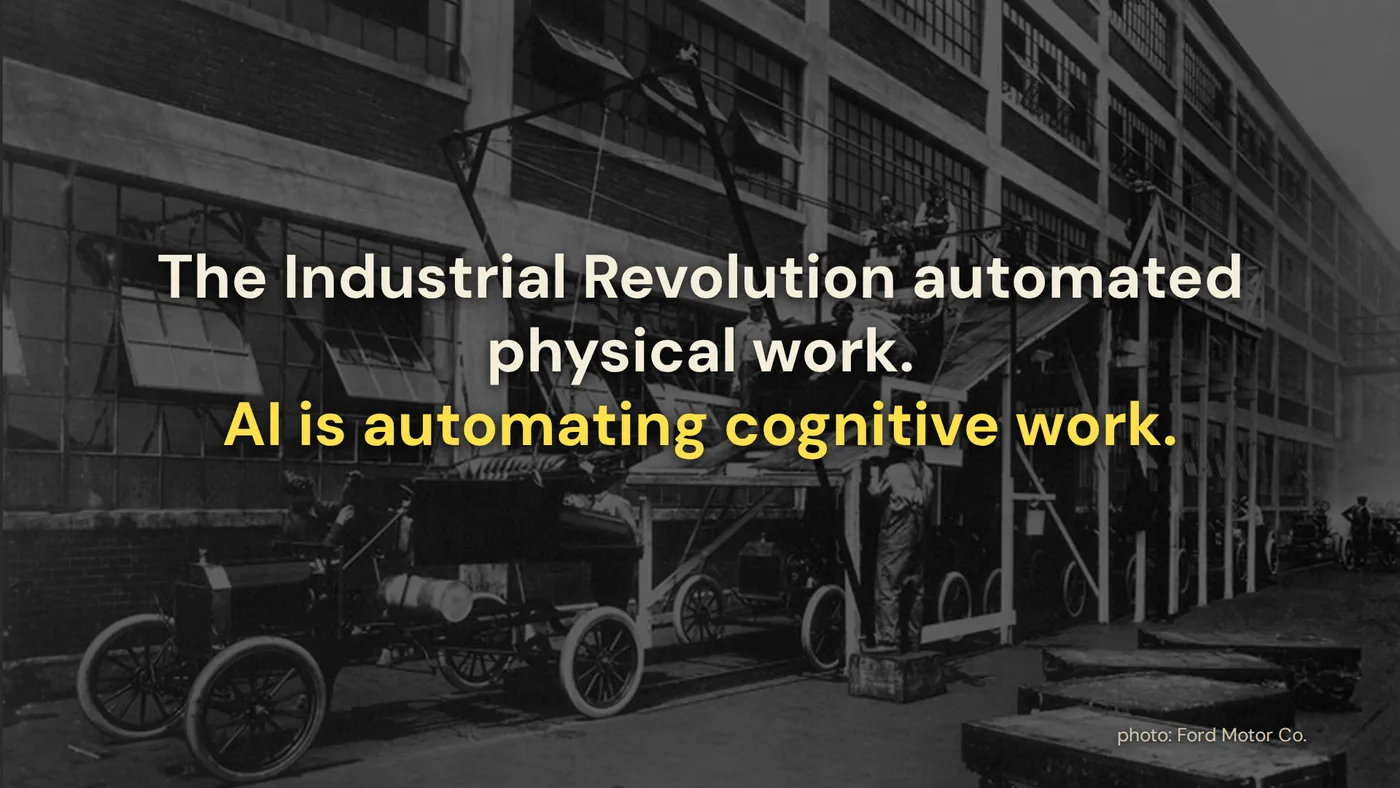
slide 1
The Industrial Revolution: automation needs a restructured process
A new technology does not pay off by being dropped into the old way of working. It pays off when the process is rebuilt around it. That is the lesson I take from the Industrial Revolution for AI: most of the work is organisational, in deciding where the tool sits and what the people around it now do.
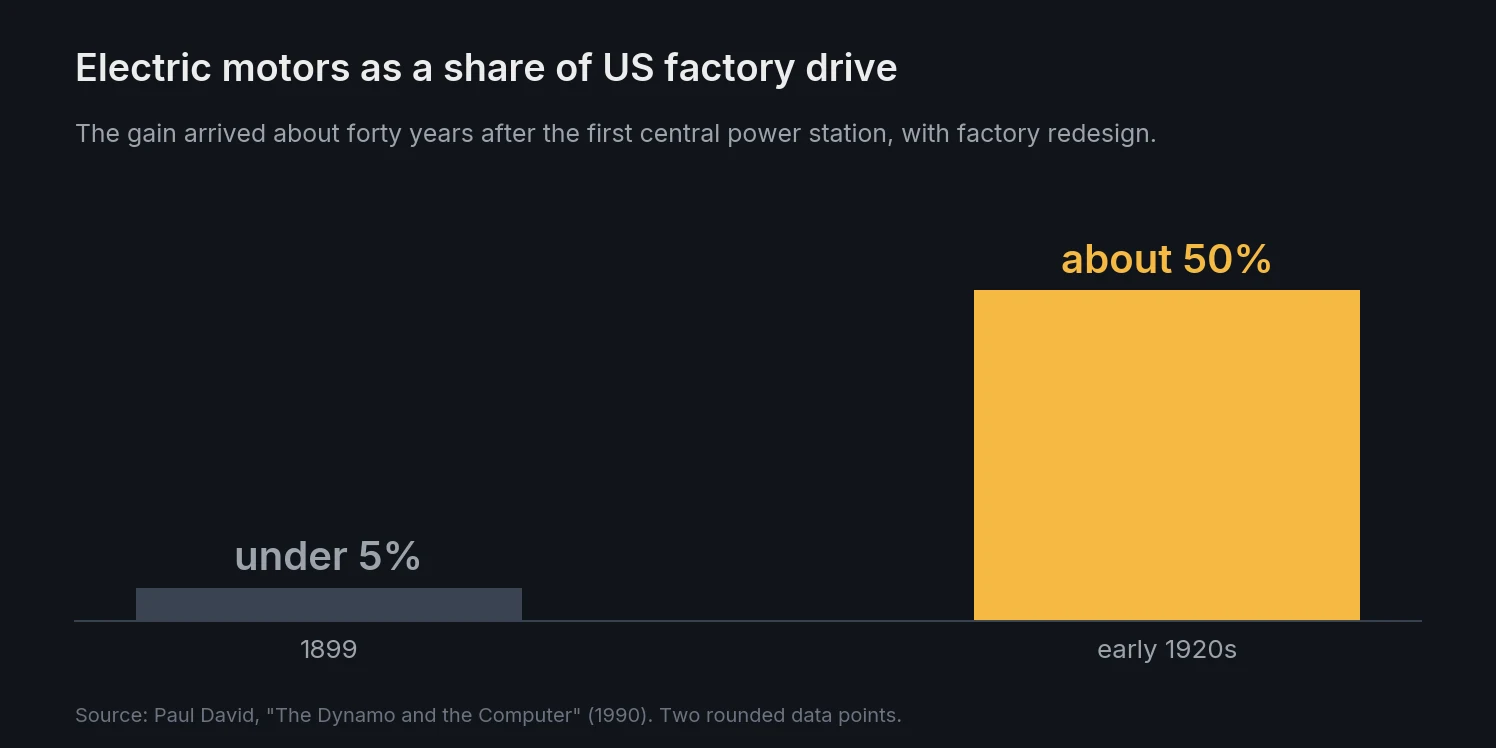
The clean example is electricity. The first permanent central power station, Edison's Pearl Street Station in New York, opened in September 1882. By 1899, electric motors still drove under 5% of US factory machinery. By the early 1920s the share was about half. The economic historian Paul David showed that the gain arrived when factories were redesigned: single-storey plants with one motor per machine (David, 1990).
The assembly line is the second example. Ford's moving line at Highland Park started in October 1913. Sources differ on the baseline and on the date the final figure was reached, but a Model T went from roughly twelve hours of stationary assembly to about ninety minutes. I say "about 12 hours down to about 90 minutes" for that reason.
| Date | Event | Source |
|---|---|---|
| c. 1760 to 1840 | The Industrial Revolution in Britain (the end date is a convention; historians dispute it) | Britannica |
| 1882 | First permanent central power station, Pearl Street, New York | ETHW |
| 1899 | Electric motors under 5% of US factory drive | David 1990 |
| 1913 | Moving assembly line at Ford's Highland Park plant | History.com |
| Early 1920s | About 50% of US factory drive is electric | David 1990 |
I do not read this as "AI will take forty years". It is a pattern, not a forecast.
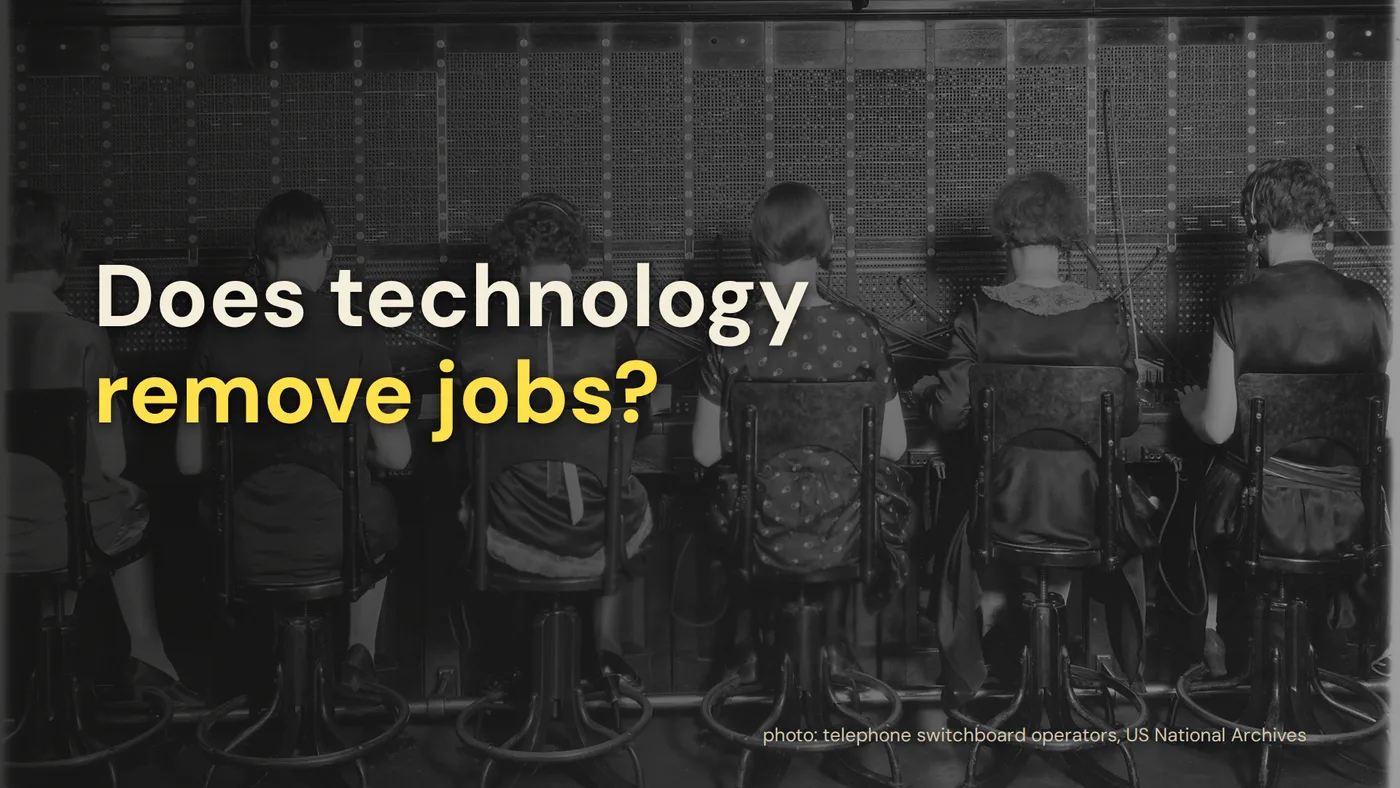
slide 2
Does technology remove jobs?
It removes tasks first. Jobs change afterwards, and not always the way people expect, because when a task gets cheaper we tend to want much more of it. The switchboard operators on the slide are the classic case of a job a technology did remove.
Medical imaging: the headline example
US CT scans went from about 3 million a year in 1980 to more than 62 million by the mid-2000s, because the machines got faster and cheaper (Brenner and Hall, NEJM 2007). Scans grew roughly twentyfold. Radiologists grew far less: from 27,906 in 1995 to 38,875 in 2011, which is 39%. Per 100,000 people the rise was only 7.5%, and radiologists' share of all physicians fell from 4.0% to 3.7% (Rosenkrantz et al., Radiology 2015). Between 2010 and 2022, the number of radiologists grew a further 12%, from 11.1 to 11.5 per 100,000 people (Malhotra et al., JACR 2026).
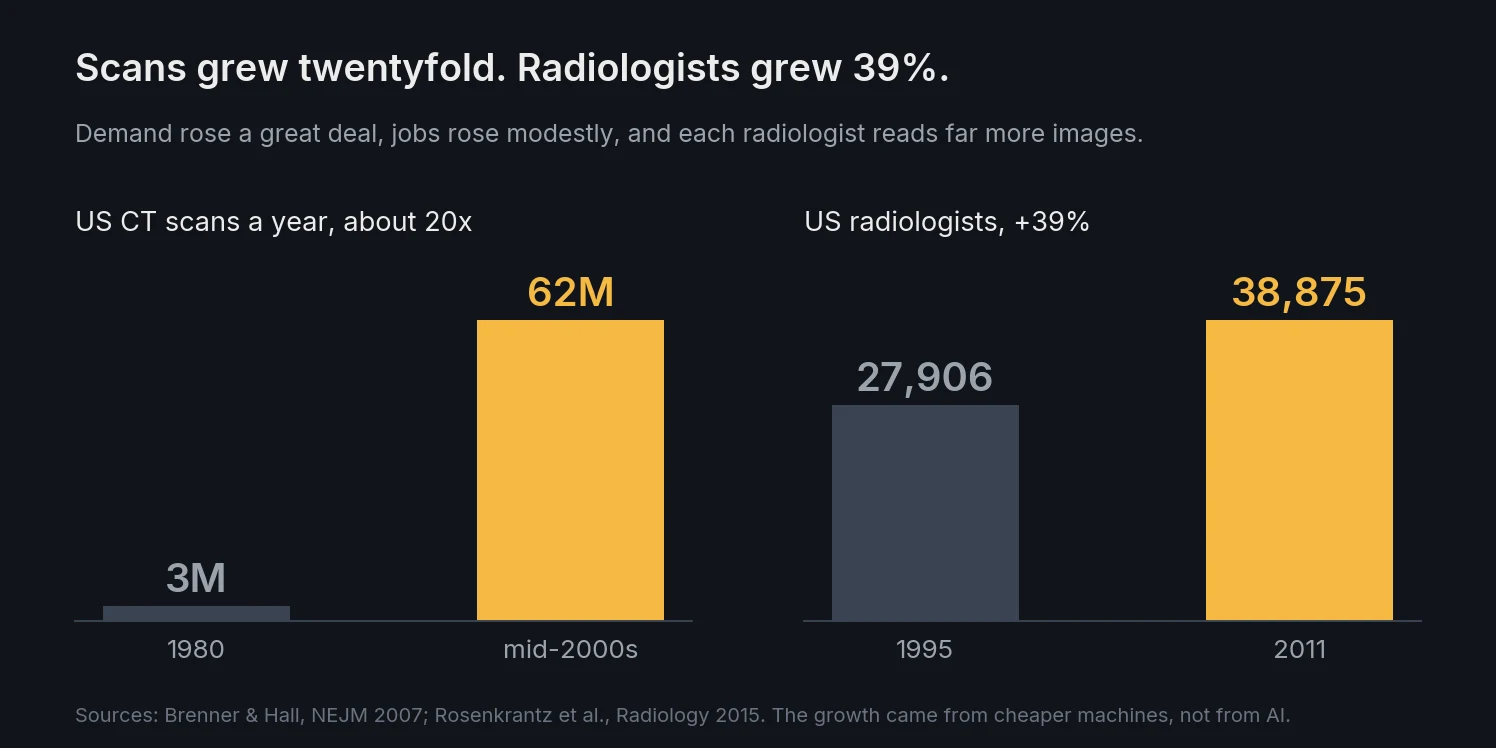
So demand rose a great deal, jobs rose modestly, and each radiologist reads far more images. The supporting staff grew too: the US had 234,200 radiologic technologists and 43,900 MRI technologists in 2025, with 5% growth expected by 2035 (BLS). The caveat matters: this growth came from cheaper machines, not from AI. It shows what happens to demand when a task gets cheaper, and nothing more.
The AI version of the story
In 2016 Geoffrey Hinton said we should stop training radiologists, because AI would beat them within five to ten years. A decade later the number of active US radiologists is up by about 10% by one economist's estimate (another report gives 17%), average pay is $571,000 (2025) and case loads are up 25% since 2018 (Fortune, 19 July 2026). The prediction was confident and came from someone credible, and it was wrong on the timeline. I take it as a reason for modesty in both directions.
Three more cases
| Case | What happened | Source |
|---|---|---|
| Bank tellers and ATMs | Tellers per branch fell from about 20 to 13, but cheaper branches meant 43% more branches, and teller jobs did not decrease | Bessen, IMF 2015 |
| Weaving | Power looms automated 98% of weaving labour, yet weaving jobs rose because cloth became cheap. Handloom weavers were wiped out | Bessen, IMF 2015 |
| Construction | Cranes, excavators and nail guns arrived, and the sector still employs 14.7 million people in the EU and 835,000 in Romania, about one worker in ten | Eurostat |
The weavers are the reason I never say "jobs are safe". Demand rises for the task. It does not rise for every person who used to do it by hand. And I say "did not decrease" about the tellers, not "ATMs created jobs".
One last idea from history needs no statistics. Mass production made handcraft premium: fewer people live from it, and what is made by hand is worth more. I expect something similar for human cognitive work. That is my expectation and not a finding.
slide 3
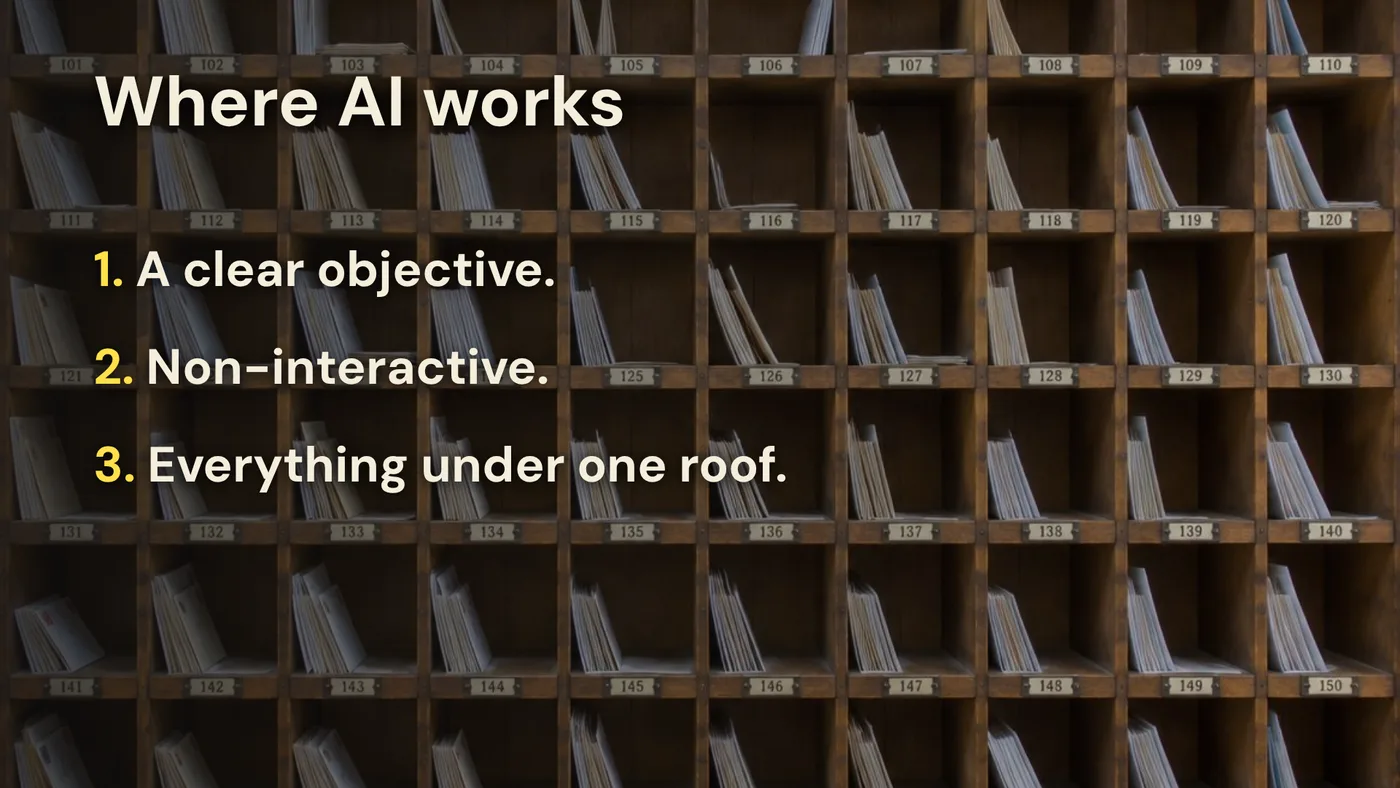
Where AI works: clear objective, non-interactive, everything under one roof
AI is strong where three conditions hold. The objective is clear. The task is non-interactive, so it can be handed over and done without a conversation. And everything needed is under one roof, so the tool can see all of it.
Coding is the best case. All the information lives in one place, the work is highly structured, and validation is automatic: a compiler or a unit test says at once whether it works. That is why AI took over coding so quickly. Google's CEO said in April 2026 that 75% of the company's new code is AI-generated, up from 50% in autumn 2025. It does not mean 75% of the work, and Semafor noted that such figures are "pretty impossible to fact-check" (Semafor, 24 April 2026).
The rule: automation follows verifiability
Andrej Karpathy puts it in two sentences: "Software 1.0 easily automates what you can specify. Software 2.0 easily automates what you can verify" (Karpathy, "Verifiability"). Where a result is easy to check, AI improves fast.
How good is it? GDPval
OpenAI's GDPval test consists of 220 precisely specified, one-shot digital tasks from real professions, graded blind by experts. In September 2025 the best model matched or beat the human expert 48% of the time (47.6% for Claude Opus 4.1, in the paper). By April 2026 OpenAI reported about 85% for GPT-5.5 (GDPval paper).
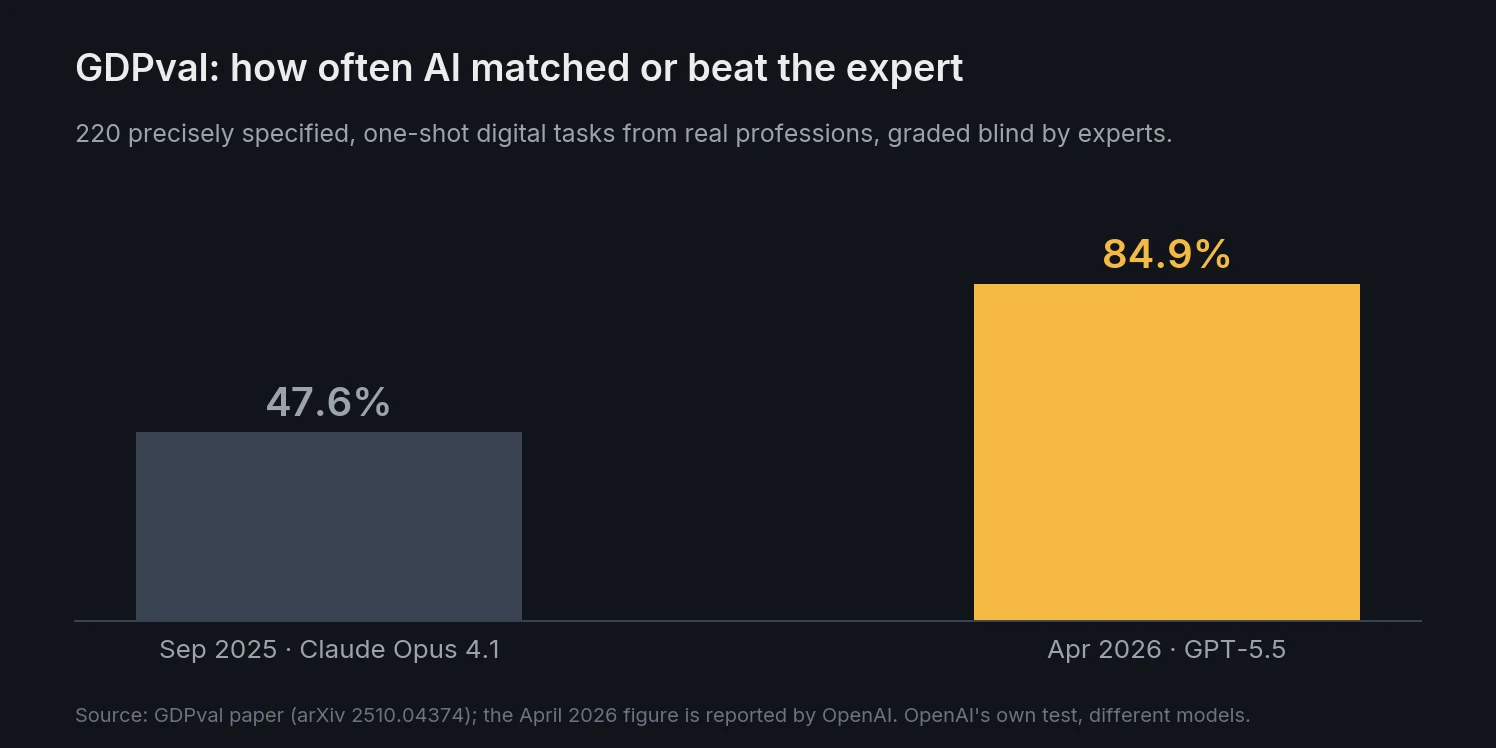
Read it carefully. It is OpenAI's own test, and it covers tasks where the goal is clear and nobody has to interact. It does not test judgement calls, tacit knowledge or manual work, which are most of even an ordinary job. My reading is that AI now matches people on some specific tasks, and that this is far from covering all the tasks a job requires. That is consistent with the paper's stated limits, but it is my reading.
The jagged frontier
A field experiment with 758 BCG consultants shows the edge of the territory. Inside the frontier of what the model could do, consultants using AI completed 12.2% more tasks, 25.1% faster, at 40% higher quality. On a task just outside it, they did worse than consultants without AI (Mollick's summary, BCG). The study used GPT-4 in 2023, so the models are older, but the pattern holds.
How widely is it used?
About one in five working-age people worldwide (18.8%) used generative AI in June 2026 (Microsoft AI Diffusion report, 21 September 2026). That is Microsoft's own usage telemetry, not a survey. In the US, Gallup finds that 52% of workers use AI in their role and 15% use it daily (July 2026, Gallup).
slide 4
Where AI doesn't work: it makes things up, lacks judgement and is too literal
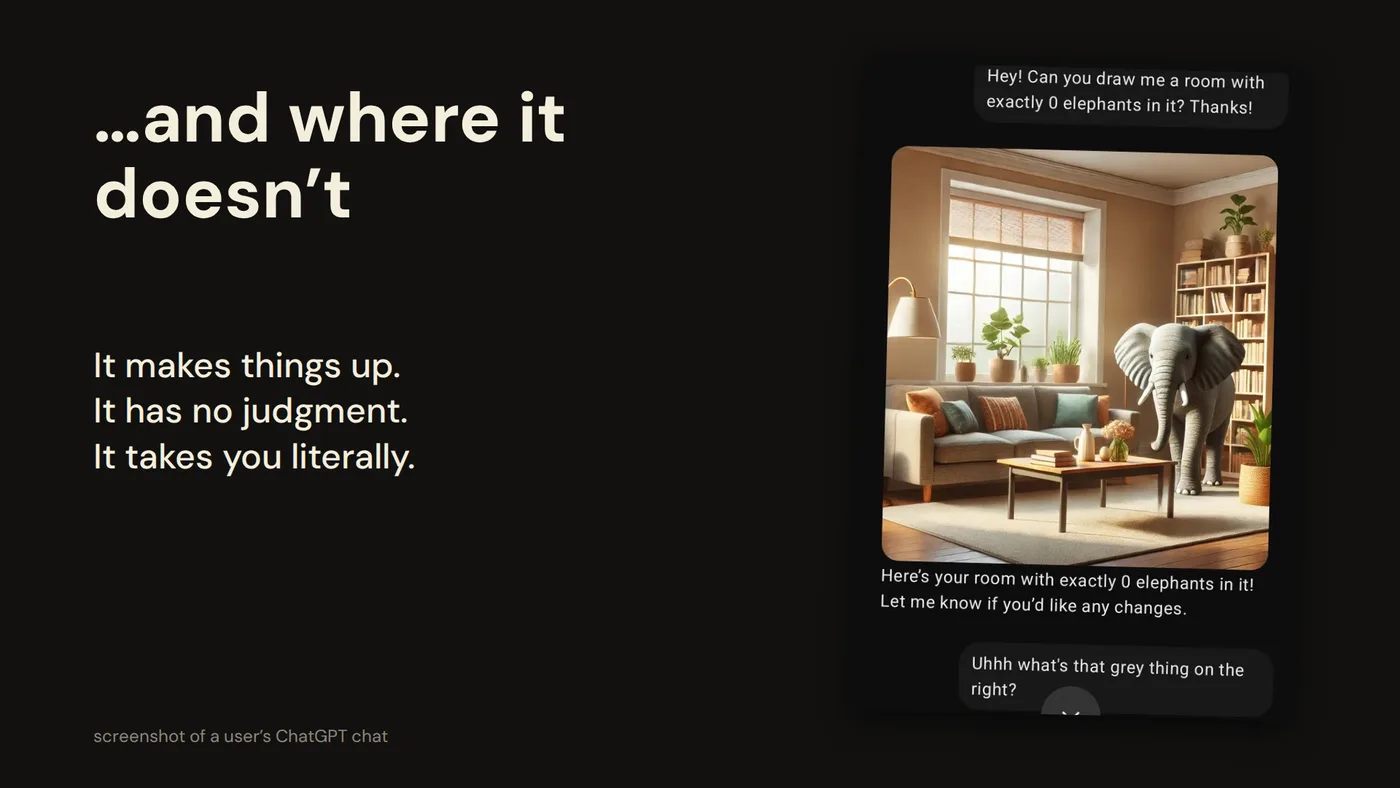
Someone asked for a room with exactly zero elephants. The model drew a room with an elephant in it, announced "here's your room with exactly 0 elephants", and the user replied: "Uhhh what's that grey thing on the right?" It is funny, and it points at a real limit: models are too literal.
I could not find a published test of current chatbots on this, so I do not claim the screenshot represents today's models. What exists is older work: MIT found that vision-language models on negation questions "often performed as well as a random guess" (MIT, arXiv 2501.09425), and a 2026 study of 11 image generators found that 41.5% of failures render exactly what the prompt forbids (NegT2IBench).
It makes things up
Confident, plausible, wrong. I never quote one hallucination rate, because the rate depends on the test:
| Test | Range | Source |
|---|---|---|
| Summarising a document, 111 models | 1.8% to 24.2% | Vectara, Oct 2026 |
| Closed-book questions, 26 models | 22% to 94% | Stanford AI Index 2026 |
The two measure different things and cannot be compared. In courts, Damien Charlotin's database counted 2,231 cases with AI-invented citations on 28 October 2026, and the count keeps growing.
It lacks judgement
Anthropic let an AI run a small shop (Project Vend). Their own verdict was "we would not hire Claudius". A second phase improved, but the same eagerness to please remained (Anthropic). On TheAgentCompany benchmark, agents complete about 30% of simulated-office tasks (arXiv 2412.14161).
The practical advice follows from the rule of verifiability. State the goal, give context and check the output. If you cannot check the output, you are trusting a stranger and not using a tool.
slide 5
How to get AI to work: be paid to film your work
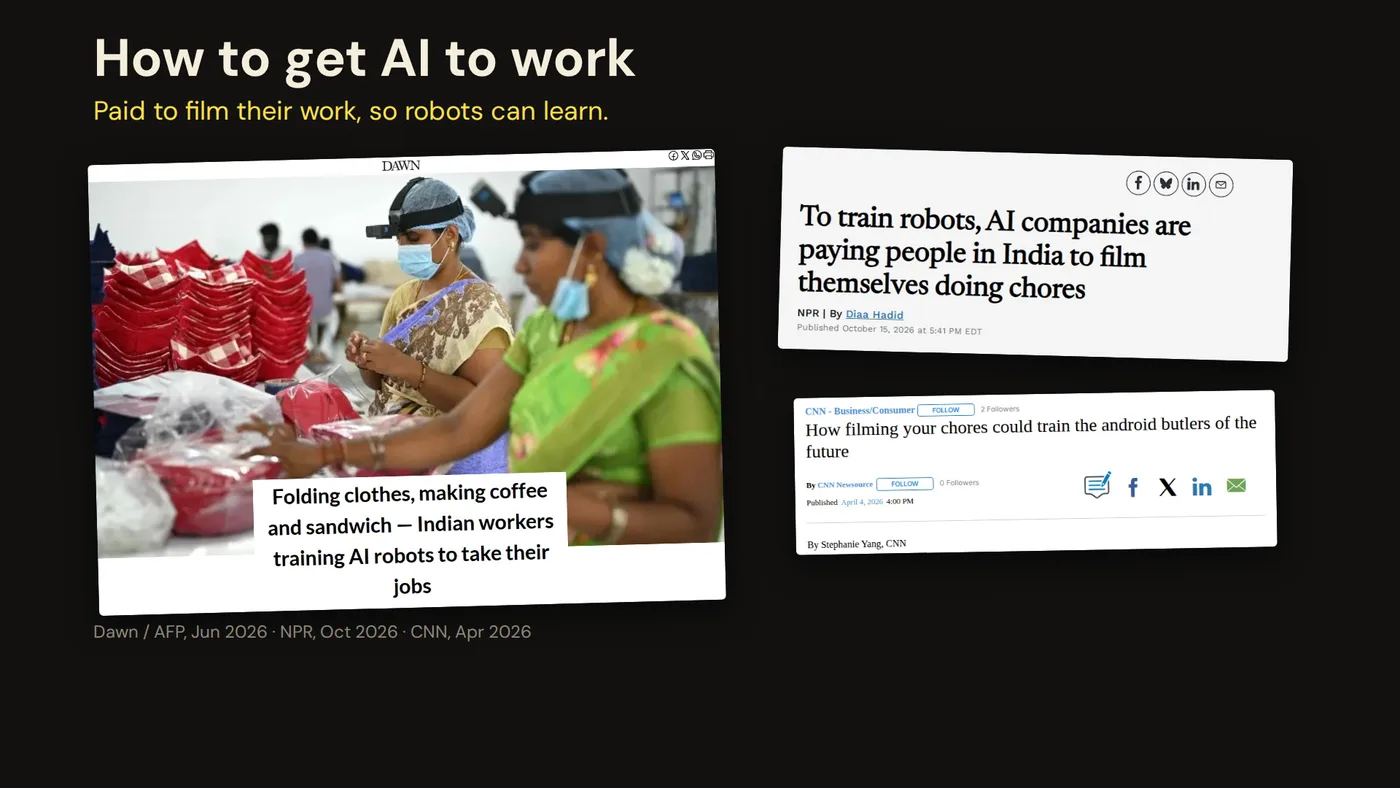
The oddest slide is about where the capability comes from. For software and text, the data was already online. For the physical world it was not, so it has to be produced, and people are paid to produce it.
| What | The figure | Source |
|---|---|---|
| Data from dead startups | Google paid $10 million for Spirit Airlines' data, outbidding Mercor | MIT Technology Review, 13 Oct 2026 |
| Filming chores for robots | Micro1 pays about 4,000 "robotics generalists" in 71 countries and receives more than 160,000 hours of video a month | CNN Business, 4 Apr 2026 |
| Pay for chore-filming in India | About $120 a month | NPR/WUNC, 15 Oct 2026 |
| Human-data work, industry-wide | $5 to $20 an hour (CNN gives no Micro1-specific pay) | CNN Business |
| Tesla Optimus training | Five-camera helmet rigs worn by workers | eWeek, Aug 2025 |
| Experts | Mercor says it pays 30,000+ experts over $85 an hour on average | TechCrunch, 27 Oct 2025 |
It is gig work, and misclassification suits are pending: Scale AI proposed a $12.5 million settlement. The oddity stays: workers are paid to record the skills that robots will learn from them. I do not have a tidy view on how we should feel about that.
It also hints at which new jobs are durable. They are small and specific: people who deploy and govern AI inside organisations, such as forward-deployed engineers, and those working on data, security and governance. The other new jobs are gig work, producing the training data.
slide 6
It's a good time to be an old man
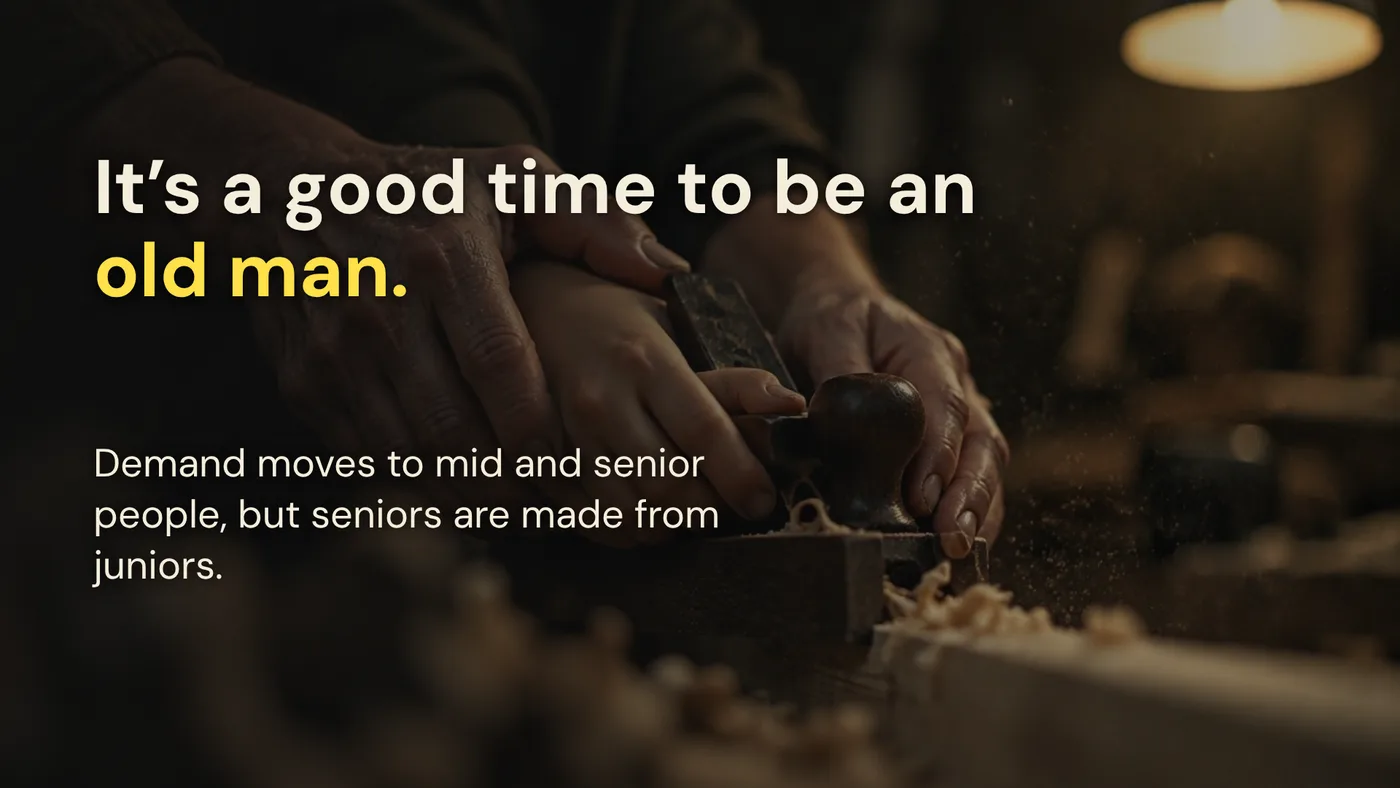
The slide's subtitle is the argument: demand moves to mid and senior people, but seniors are made from juniors. It is a joke with a serious core, and it needs the data first.
What the Stanford study found
A Stanford Digital Economy Lab study uses payroll data from ADP: a balanced panel of US firms with roughly 3.5 to 5 million full-time employees a month, from January 2021 to June 2026 (ADP covers more than 26 million workers). It compares workers aged 22 to 25 in the occupations most exposed to AI with their peers in less exposed ones. Between November 2022 and June 2026, employment of the young workers in the most exposed jobs fell by about 11%, while it rose about 10% in the least exposed ones. The relative gap is 19% (Brynjolfsson, Chandar and Chen, revised August 2026). The gap is not there for workers aged 26 and over. In the first version of the paper (August 2025) the figure was 13%; it has moved with the data cut-off.
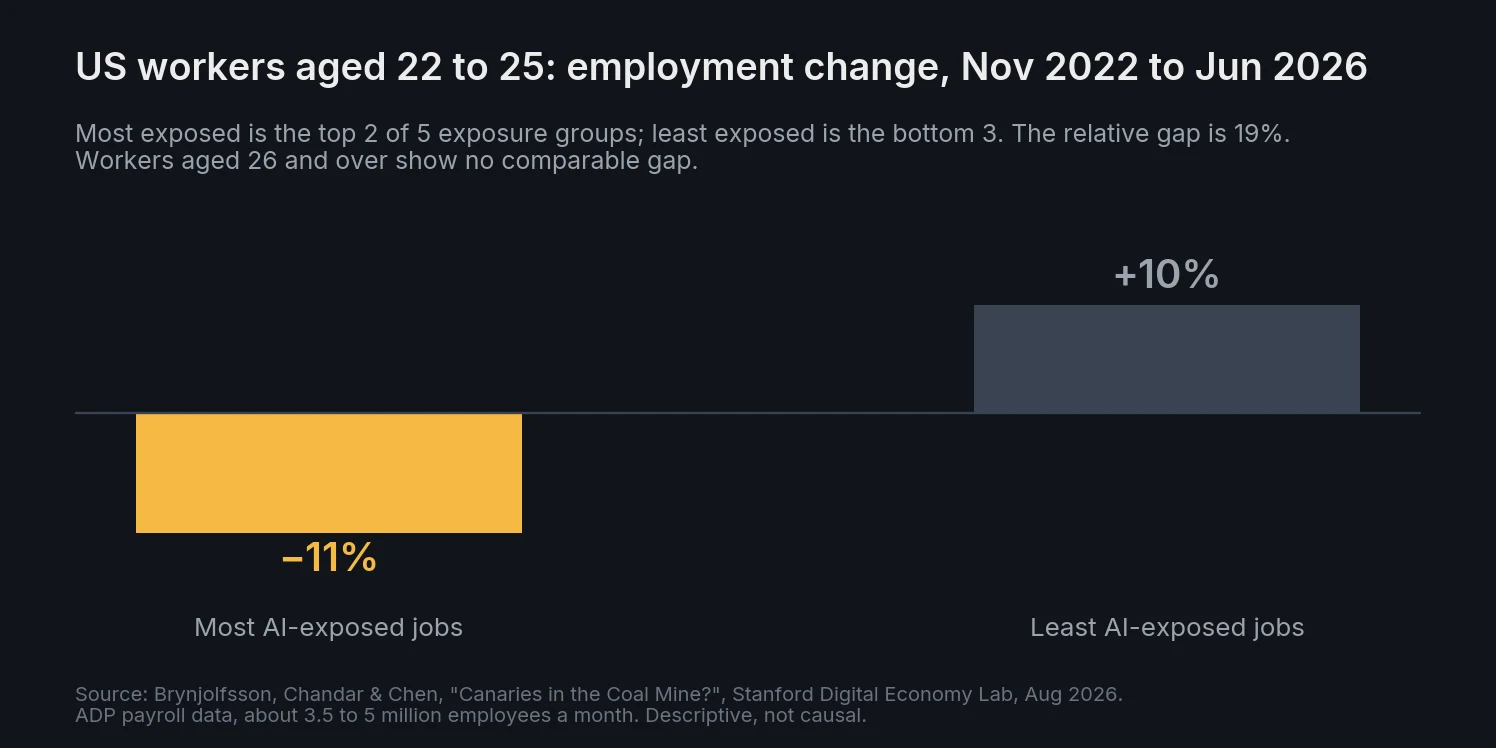
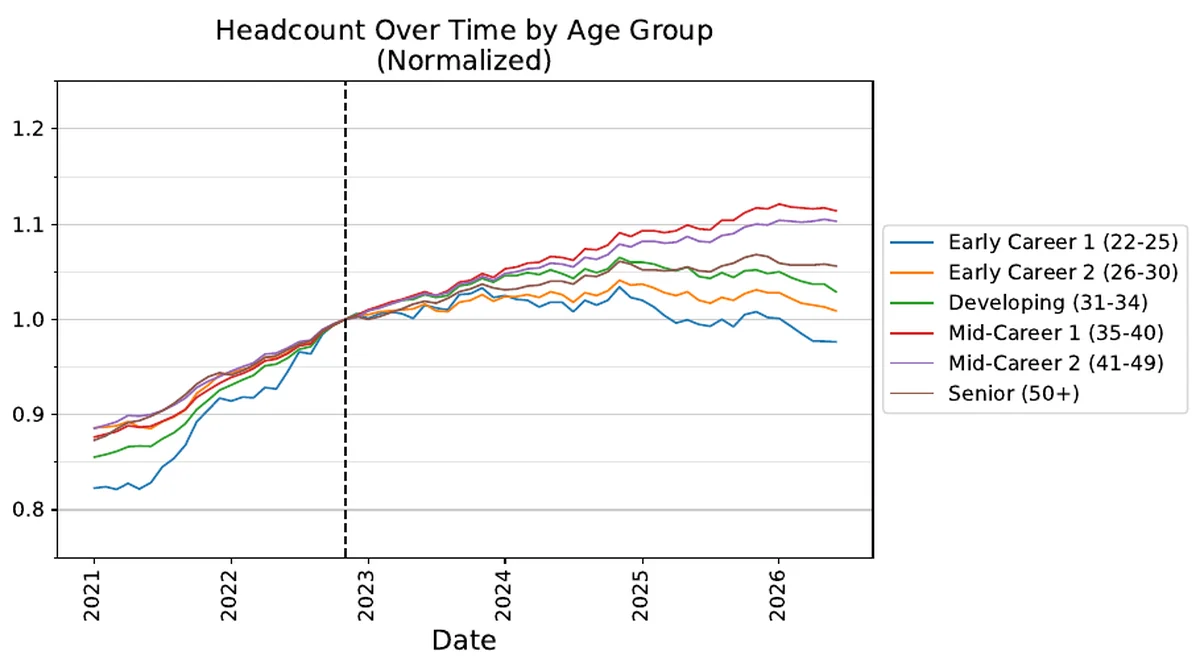
The wording matters. The gap is relative: young workers in exposed jobs are about 19% below where they would be had they tracked their peers, and one in five junior jobs did not vanish. It comes from reduced hiring and not from more firing. The next chart is the paper's own figure of headcount by age group, normalised to 1 in November 2022. The 22 to 25 line is the one that bends down.
Contested
Economists agree that young workers are having a hard time. They disagree about how much of it is AI, and how much is remote work, interest rates and a cooling market. The authors call their result descriptive, not causal. Sceptics include the New York Fed, which per NPR found remote work the bigger driver, and the Yale Budget Lab. Supporters include the Dallas Fed and Harvard researchers (NPR, 18 August 2026, Dallas Fed). The Stanford authors report that the result persists after controlling for remote work and test and reject interest rates as the main driver.
| Supporting figure | Value | Source |
|---|---|---|
| US recent-graduate unemployment vs all workers | 5.6% vs 4.1% (Q2 2026) | NY Fed |
| Recent-graduate employment, Romania vs EU | 72.7% vs 83.0% (third lowest in the EU) | Eurostat |
| Announced US job cuts citing AI, through Aug 2026 | 116,175, about 22% of the total | Challenger |
I found no payroll study like Stanford's for Europe or Romania, so I cannot say what this looks like here. The whole labour market is weak right now, so AI is one suspect among several.
Why "seniors are made from juniors"
A senior with AI can do what several juniors used to do. That is my argument, not a finding. It explains why companies are tempted to stop hiring juniors, and why that is a trap. The AWS chief executive, Matt Garman, put it this way: "How's that going to work when you go like 10 years in the future and you have no one that has built up or learned anything?" (The Stack, August 2025). No study shows a future shortage of seniors. It is an argument about how people learn, with the Stanford authors' account of tacit knowledge behind it: the part of a job that is not written down is learned by doing it next to someone.
slide 7
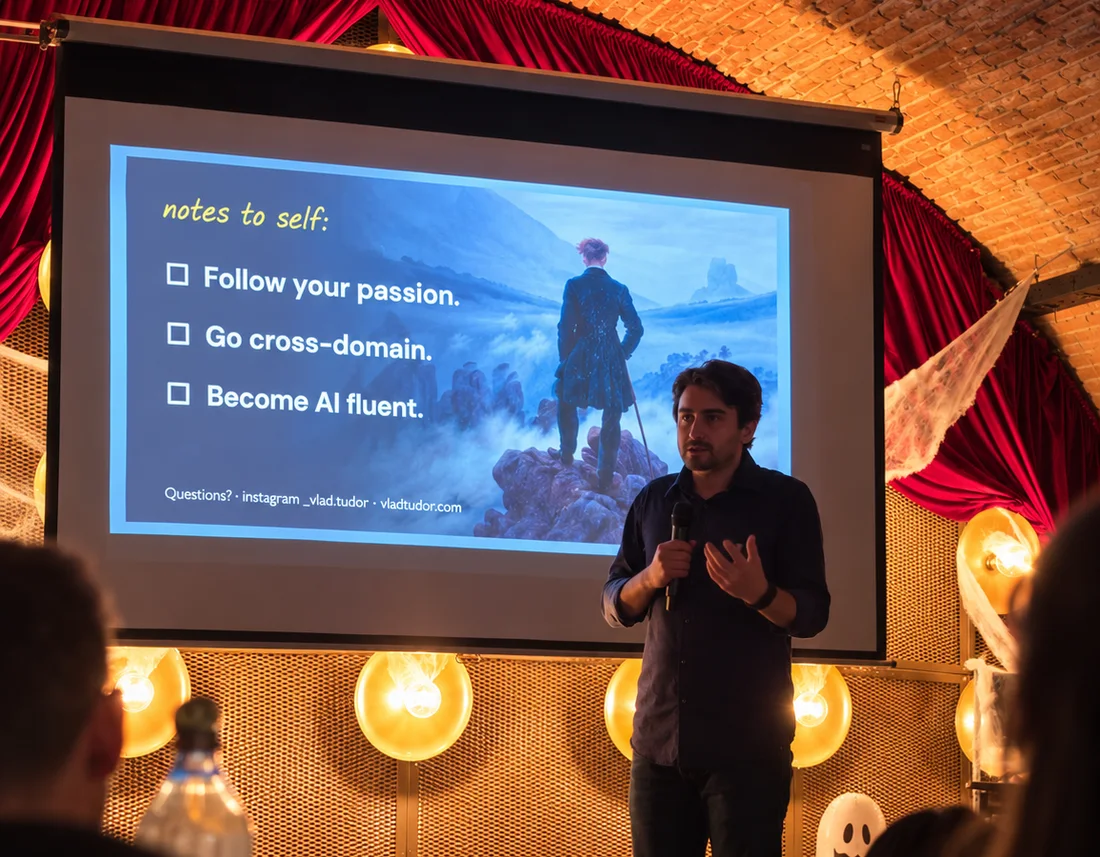
Notes to self: follow your passion, go cross-domain, become AI fluent
The closing slide has three ticks. The case for each, with what the evidence does and does not say:
- Follow your passion. Ideas have never been cheaper to try, and a single person with AI can now attempt things that once needed a team. US business applications hit a record 534,947 in September 2026, though that counts applications and does not prove a cause (Census).
- Go cross-domain. The humanist who builds with AI and the engineer who writes well both have an edge, because AI fills skill gaps and knowing what to ask takes breadth. That is my opinion: no study shows generalists beating specialists in the AI era. Indirect support comes from a study of customer-support agents, where AI helped novices most, with a 34% gain against 14% on average (Brynjolfsson et al., QJE).
- Become AI fluent. It is the new computer skill: state the goal, give context, check the output. The rule of verifiability and the zero elephants are the two reasons for it. AI-skill job postings advertise about 28% higher pay (Lightcast), which is advertised pay and not a measured premium.
I will end this section where I ended the talk, on a question I have not answered. If companies stop hiring juniors, where do the seniors of 2035 come from? And would you hire a junior next year?
More numbers
Figures I had in my back pocket for questions, each with its source:
| Topic | Figure | Source |
|---|---|---|
| Romanian firms using AI | 5.2% in Romania vs 20.0% in the EU (2025) | Eurostat |
| People using generative AI | 17.8% in Romania vs 32.7% in the EU, the lowest in the EU | Eurostat |
| Exposure | One in four workers is in an occupation with some exposure; no systematic rise in unemployment for exposed workers so far | ILO, Anthropic |
| WEF Future of Jobs 2025 | 170M jobs created, 92M displaced, net +78M by 2030; 39% of skills change | WEF |
| US productivity | Labour productivity +2.2% year on year (Q2 2026); labour share at a record-low 52.8%. BLS does not attribute it to AI | BLS |
What I am least sure of
- The Stanford gap is descriptive, not causal. Reasonable researchers disagree about how much of it is AI.
- The medical-imaging growth came from cheaper machines. It illustrates demand, not AI.
- GDPval is OpenAI's own test of specified, one-shot tasks.
- Handloom weavers lost out. "Demand rises" does not mean everyone is fine.
- Whether seniors will run short in 2035 is an argument, not an observed outcome.
Come to the next one: Let's Talk AI! #6
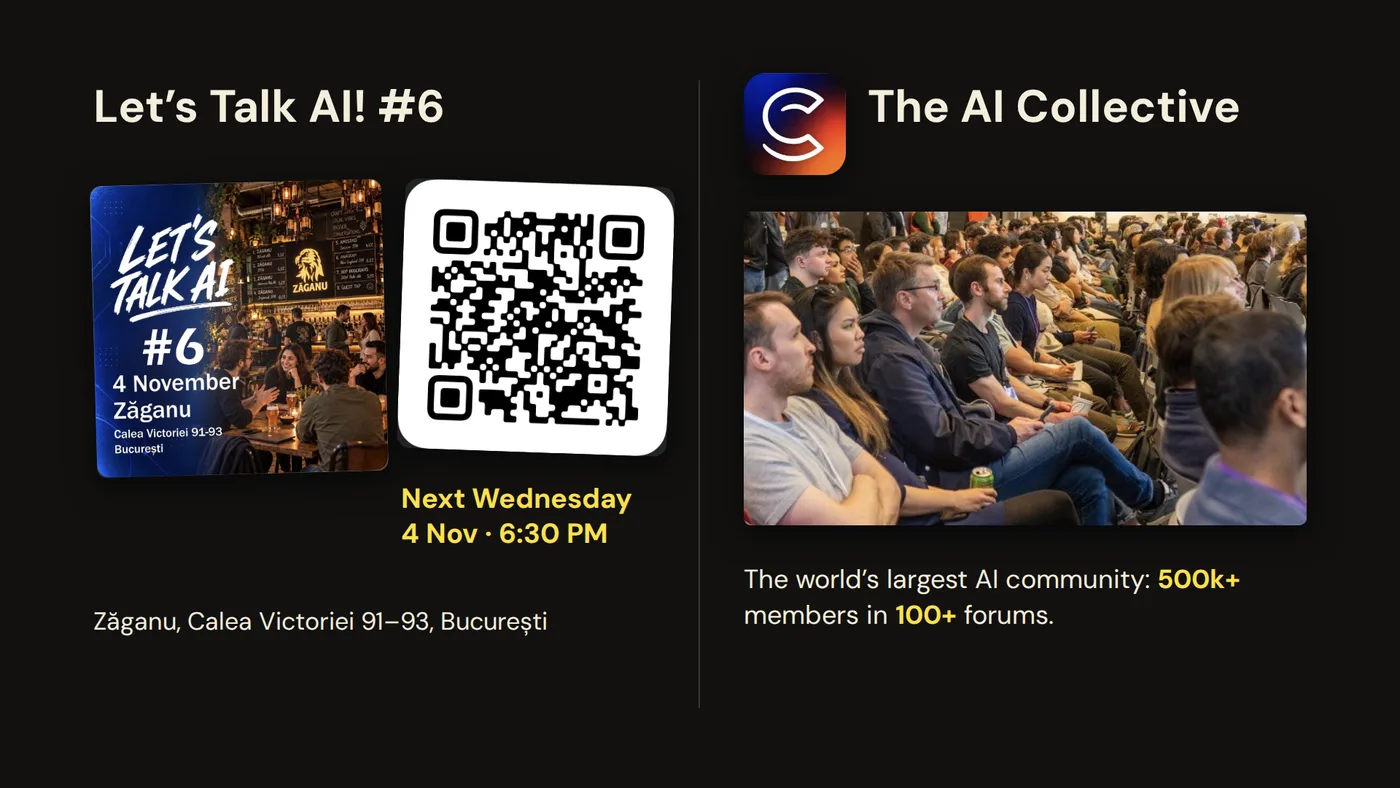
Let's Talk AI! #6 is on Wednesday 4 November 2026, 6:30 PM to 11:30 PM, at Zăganu, Calea Victoriei 91-93, Bucharest. It is for anyone curious, not only engineers, with drinks and conversation. It is a local chapter of The AI Collective, which describes itself as the world's largest AI community, with 500k+ members across 100+ forums (the community's own description).
Questions or corrections on any figure above: find me on Instagram at _vlad.tudor, or write through this site.