An AI agent is a program that receives a goal rather than a list of steps, and decides for itself which steps to take to reach it: it reads documents, searches your company's systems, uses tools, takes actions and checks whether it has finished. A chatbot only answers questions. Classic automation only executes fixed rules.
"Agent" has been on every sales deck since 2025, so it is worth starting from scratch, without jargon. I have been building AI systems for companies since before ChatGPT became a board-meeting topic, and the most useful distinction I know is not technical. It is a question: who decides the next step?
What exactly is an AI agent?
An AI agent is a system in which a language model (LLM) runs the execution of a task itself: it chooses which tool to use, what to look up, what to do next and when it is done. What separates it from ordinary software is that the steps are not written in advance.
OpenAI's guide to agents has a short definition: "Agents are systems that independently accomplish tasks on your behalf". It adds that applications which use an LLM without letting it control the workflow ("simple chatbots, single-turn LLMs, or sentiment classifiers") are not agents (OpenAI, A practical guide to building agents, read 26 September 2026). Anthropic draws the same line between workflows, where the steps are fixed in code, and agents, where the model "dynamically directs" its own process and tool use (Anthropic, Building effective agents, December 2024, read 26 September 2026).
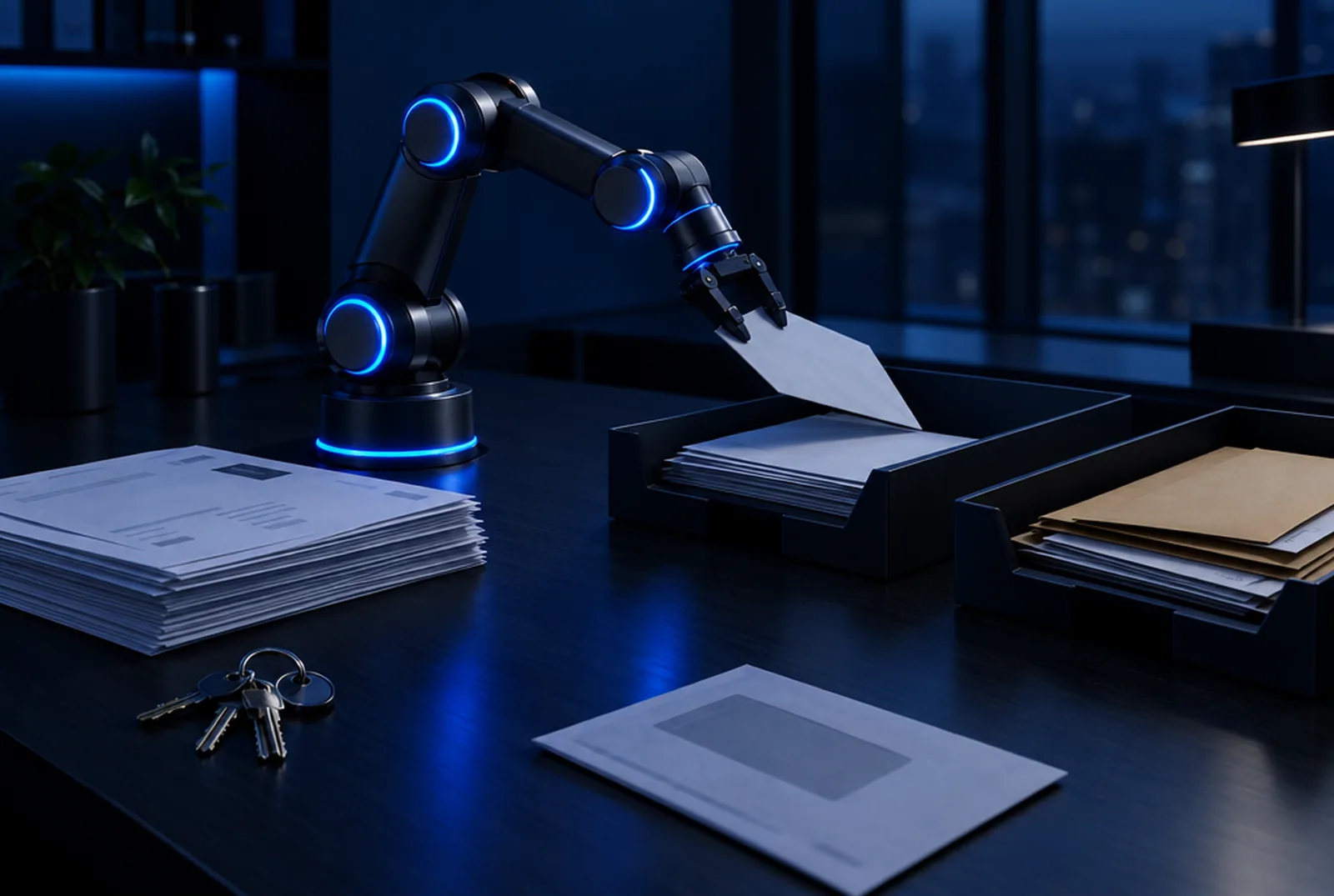
In business terms, think of a new hire. A chatbot is the colleague at reception who answers questions but has access to nothing. Classic automation is a conveyor belt: it does exactly the same thing, quickly, without asking. An agent is the new hire you give a goal ("get the supplier invoices ready for approval"), a set of keys (the inbox, the ERP, the accounting software) and a few rules. The rest, they work out.
It is a point I come back to often: AI optimises towards an objective, but a human sets the objective. An agent is good at the middle of the work, breaking the goal into steps and carrying them out. Framing the goal and judging whether the result is good stay with you.
What is the difference between a chatbot, classic automation (RPA) and an AI agent?
In short: the chatbot talks, automation follows rules, the agent decides the steps and acts. The human remains the only one accountable for the result.
| Chatbot | Classic automation / RPA | AI agent | Human | |
|---|---|---|---|---|
| What it receives | A question | An input in a fixed format | A goal | A goal and the company's context |
| Who decides the steps | Nobody; it answers once | The developer, in advance | The model, as it goes | The person |
| Can it act in your systems? | Usually not | Yes, only along the scripted steps | Yes, through the tools and permissions it is given | Yes |
| What it does with an exception | Says something plausible | Stops, or fails quietly | Tries a fix, good or not | Solves it or asks |
| How it fails | Wrong information | Predictably, at the same rule | Less often, but harder to anticipate | Gets tired, forgets, is inconsistent |
| Where it fits | FAQs, information | Stable steps, structured data | Documents, emails, decisions with variation | Judgement, relationships, accountability |
My decision rule is simple. If you can write every step on one page and the steps do not change, you need classic automation, not an agent. It is cheaper, more predictable and easier to check. An agent earns its place where the input is unstructured (an email, a scanned PDF, a tender specification) or where the rules have so many exceptions that nobody can write them down any more. OpenAI gives the same three criteria: complex decisions, rules that are hard to maintain, and reliance on unstructured data. I wrote separately about how to spot what is worth automating, and many good candidates do not need an agent at all.
What do AI agents look like in a real company?
Less spectacular than in the demos: a good agent takes over a repetitive task that has variations, prepares the work, and leaves any decision with consequences to a person. Here are six examples. The first three are hypothetical scenarios in a Romanian company, to show the pattern; the last three are real projects.
- Supplier invoices (hypothetical). Imagine a distributor whose B2B invoices arrive through Romania's national e-Factura system, as structured files. The agent matches each invoice to the purchase order and the goods receipt, flags differences in quantity or price, and prepares the entry in the accounting software (SAGA, SmartBill or whatever the firm uses). The accountant approves. Matching on clear rules is classic automation; the agent comes in where an invoice does not match and someone has to find out why.
- Customer emails (hypothetical). The agent reads the email, works out whether it is an order, a complaint or a question, looks up the order status in the ERP and drafts a reply. Someone in customer service reads it and sends it. The gain is the time spent searching, not the writing.
- Requests for quotation (hypothetical). A customer sends a product list in a PDF or in the body of an email. The agent extracts the line items, checks stock and the price list, and prepares the quote for the salesperson, who adjusts it and sends it.
- Public tenders. At Sapio we built an agent that reads the notices on e-licitatie.ro, Romania's public procurement platform, and compares them with a company profile built from its past projects. In testing it found the relevant tenders. It is tested, not in production, so there are no time-saved figures, and I will not invent any.
- Retail. At Sapio we built a ChatGPT-integrated AI agent for retail, for a client that raised a $4.7M seed round.
- Legal research. ai-aflat.ro, the free assistant I built for Romanian legislation, searches more than 220,000 legislative acts, updated daily, and cites the law with a link to the official source. Technically it sits closer to a research assistant than to an agent: it searches, compares and answers, but it never acts on your behalf and, deliberately, never gives verdicts. It is a useful example precisely because it shows where I chose to stop the autonomy.
See the pattern? In all six, a human stays on the last step.
Where do AI agents break?
In four places: permissions, evaluation, exceptions and the absence of a human in the loop. In my view, the model is rarely the problem.
Permissions. An agent can do anything its keys allow. If it has write access to the ERP, it can write the wrong thing to the ERP. The rule is the one you use for a new hire: broad read access, narrow write access, and any action that costs money or goes out to a customer passes through a person.
Evaluation. "It seems to work" is not a measurement. Before launch you need a set of real cases with the correct answer known in advance, and you run the agent against it after every change. Without it you cannot tell whether today's version is better than yesterday's.
Exceptions. An agent takes dozens of steps, and a small mistake at step two carries forward. Anthropic says it plainly: agents' autonomy means "higher costs, and the potential for compounding errors", and it recommends extensive testing in sandboxed environments with clear guardrails. The invoice with the wrong VAT rate, the customer who writes in three languages in one email, the tender with a crooked scanned annex: that is where quality shows.
The human in the loop. I think the best systems do not remove the person; they move them, from doing the work to approving it. The agent has to know when to stop and hand the case to someone.
There is also a market trap: not everything sold as an agent is one. Gartner estimates that of the thousands of vendors calling themselves "agentic", only around 130 offer real agentic features; the rest is agent washing (Search Engine Land, reporting Gartner, read 26 September 2026). The question to ask a vendor is the one from the start: who decides the next step?
Do I need an AI agent, or is a chatbot enough?
If your people lose time looking for information, an assistant that answers from the company's documents is often enough; for a general assistant, see ChatGPT vs Copilot for business. If they lose time doing the same operation across three systems, you need automation, and an agent only comes in where the operation has variations the rules do not catch. It is tempting to start with the agent because it sounds better in a meeting. I think it is the most expensive place to start.
How do I start with AI agents?
With one process, not with a tool. The steps I recommend:
- Pick a task that repeats dozens of times a week and that people already complain about.
- Write down the steps a person follows today, including the exceptions and who decides them.
- Cut out everything that is a fixed rule and give it to classic automation. What is left is the agent candidate.
- Collect a set of real cases with the correct outcome, dozens rather than a handful. That is your evaluation set.
- Start the agent in "propose" mode: it prepares, a person approves. Measure how much of what it proposes is accepted without changes.
- Widen its autonomy only where the numbers support it, one step at a time.
The longer version, for the whole company, is in my step-by-step guide to implementing AI, and the reasons agents and other AI projects stall are in why AI is not delivering results. If you are at the build stage, we build AI agents at Sapio, with exactly the rules above.
Back to the new hire. Nobody hands over the keys to the till on day one, however bright the person is. Not out of distrust, but because trust is built on cases you have seen. AI agents are the same, except that this time we can count the cases.
If you want to look together at which of your processes would fit: AI consulting for operations.